
DOC Is a Maryland Division
Maryland does not have a standalone agency officially named the Maryland Department of Corrections, and MDOC is not the official abbreviation. The cabinet department is the Maryland Department of Public Safety and Correctional Services, or DPSCS. Its prison-operating component is the Division of Correction, or DOC. The distinction points a search to the right public locator, records custodian, parole body, and supervision division. It also prevents a county jail record from being mistaken for a DOC record.
The official Division of Correction page identifies DOC and its role within DPSCS.
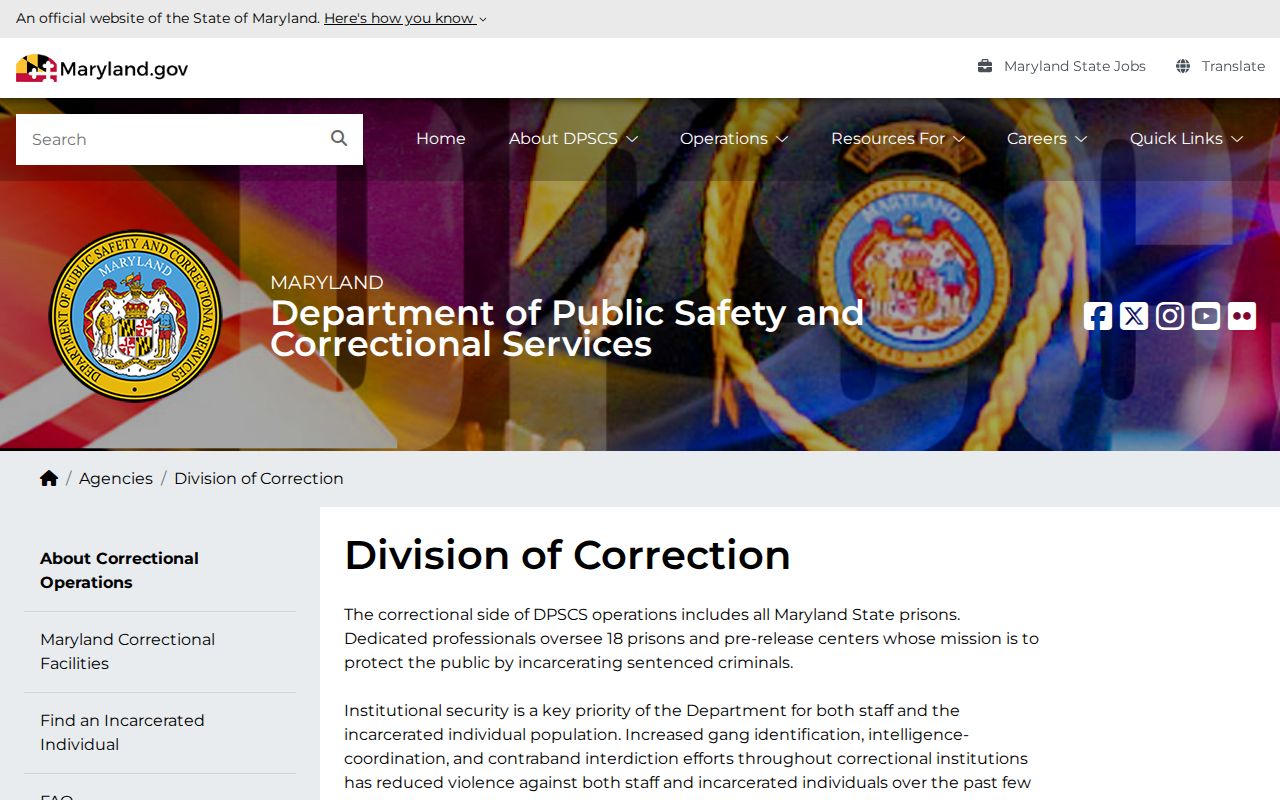
The page confirms that DOC is the division responsible for the state prison system, while other DPSCS divisions have distinct functions.
A Maryland DOC offender search is a common user phrase, but the official tool is named the DPSCS Incarcerated Individual Locator. The Maryland Parole Commission makes parole decisions. The Division of Parole and Probation handles community supervision within its authority. Local detention centers outside Baltimore City's state-operated system generally answer to county custodians. Those divisions and local offices do not merge their records into one public released-inmate profile.
- DPSCS
- The Maryland cabinet department that contains correctional, parole, supervision, and related public-safety divisions.
- DOC
- The Division of Correction, which operates Maryland state prisons.
- MPC
- The Maryland Parole Commission, the body that decides parole matters.
- DPP
- The Division of Parole and Probation, which handles covered community supervision.
How the DOC Offender Search Works
The DPSCS Incarcerated Individual Locator accepts a first and last name. DPSCS describes it as a current-facility search for certain people committed to the Commissioner of Correction and held in DOC facilities, Patuxent Institution, and some people serving short sentences in Division of Pretrial and Detention Services facilities. It is not described as a full correctional history. DPSCS also warns that it does not include every person in its custody.
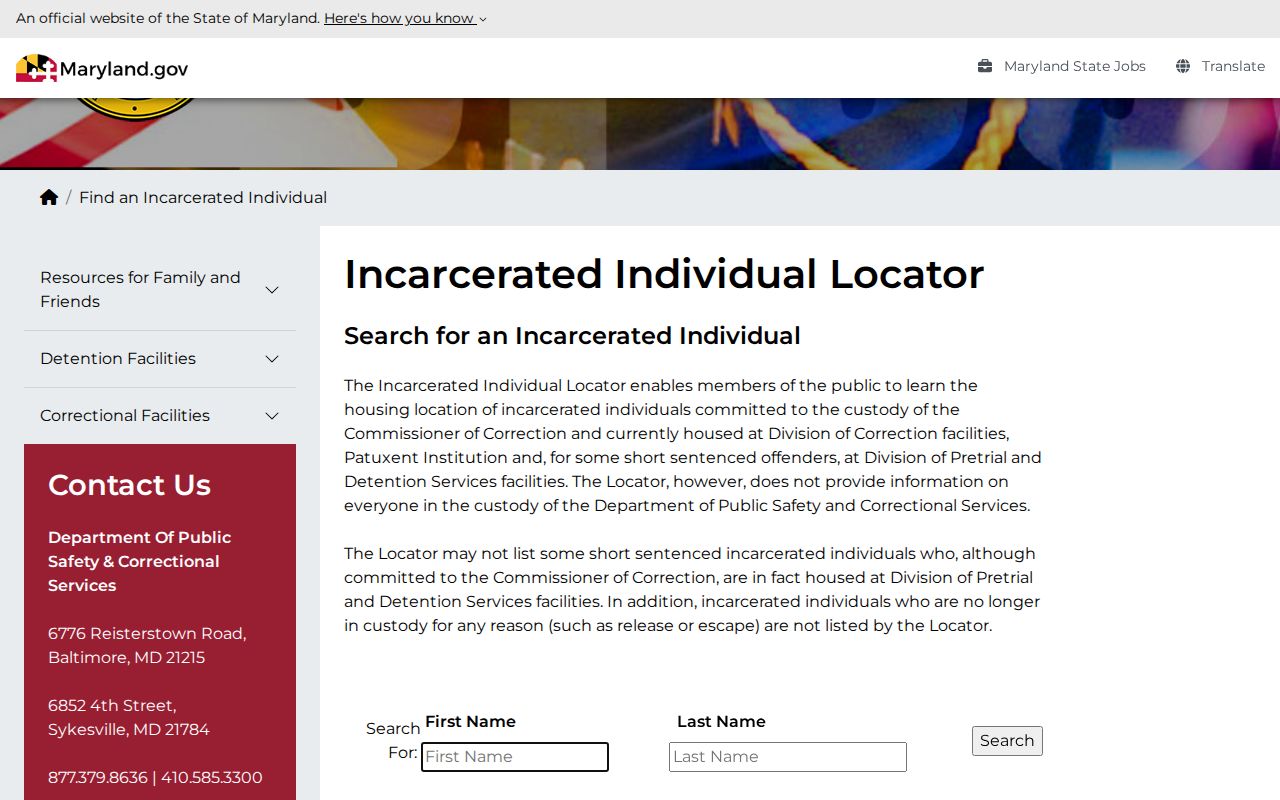
The locator notice expressly excludes people who are no longer in custody, which controls how every blank result must be read.
For a current-custody check, use the legal first and last name. Try a verified spelling variation only when one is known, then compare any match with known identifiers and the expected custody path. A match can support current covered DPSCS placement. If someone disappears from a county jail and appears in this locator, the likely event is a commitment or transfer into state custody, not a community release. The sentencing docket or commitment record should confirm that move.
- Open the official locator explanation and read its current scope and exclusion notice.
- Enter the person's legal first and last name in the linked search application.
- Compare any result with known case, identity, and facility facts before treating it as the same person.
- Use a match only as evidence of current covered placement, not as a sentence or release calculation.
- If no match appears, continue to VINE, the sentencing court, the last custodian, and records requests.
The DOC FAQ also lists current-custody Data Processing telephone numbers at 410-585-3350, 410-585-3351, and 410-585-3352. Callers should have identifying details available. That telephone route still concerns current custody and does not turn the public locator into a former-person search.
DOC Released Records Are Not Public Profiles
A released or discharged person does not appear in the public Maryland DOC offender search. DPSCS states that a person no longer in custody for any reason, including release or escape, is not listed. The tool therefore has no public released or discharged result, no actual release-date field for a former person, no release type, no supervision-to-follow field, no projected or tentative date, and no historical retention window. Any page or search result that attributes those fields to the public Maryland locator is describing a feature the official source does not provide.
A no-result is a branching point. It may mean community release, escape, a name mismatch, county rather than state custody, federal or immigration custody, a person outside the tool's covered population, or no Maryland state commitment at all. The absence cannot distinguish those events. Affirmative proof must come from a record that states what happened.
| Question or field | Public DOC locator answer | Better source after custody |
|---|---|---|
| Current covered state placement | May show a location for a matching person | Locator result plus agency confirmation |
| Released or discharged status | Not displayed | VINE event or DPSCS release record |
| Actual release date | Not displayed after release | Custodial release event |
| Release type | Not displayed | Court, parole, mandatory-supervision, or discharge order |
| Projected release date | No public field | Authorized sentence computation or victim-services channel |
| Supervision after release | Not displayed | MPC order, sentencing case, or DPP record |
| Former-person history | No public retained profile | Focused records request and court file |
No-result limit: A blank Maryland DOC offender search cannot prove lawful release because the same screen can follow release, escape, transfer, mismatch, or excluded coverage.
Note: The public search supports current covered custody, but a blank result cannot establish the event that ended it.
Verify a Maryland DOC Release
Verification begins by separating the legal authority from the completed event. A court order, parole approval, or mandatory-supervision order can authorize an exit. The custody record establishes when staff processed it. A receiving-agency record can show that the exit was a transfer. A maximum-expiration computation distinguishes final sentence discharge from conditional time in the community.
- Identify the last known custodian and court case, including whether the person was local, state, federal, or immigration custody.
- Run the DOC offender search only to test current covered state placement.
- Search Maryland VINE and compare identifiers, source agency, status, location, and any event date shown.
- Review Maryland Judiciary Case Search, then obtain the actual sentencing, release, commitment, or parole order from the clerk.
- Check MPC and the correct DPP office if parole or mandatory supervision may still apply.
- Request the DPSCS release event, sentence computation, credit ledger, or discharge record with a precise date range.
Maryland VINE can report described custody changes and other events. A displayed release date should be preserved with the exact source wording, then compared with the court or agency document that states the legal basis. A move to another facility should be treated as a possible transfer. Registration may need to be repeated when a person crosses from local detention to state prison or then into community supervision.
Does a parole approval equal release? No. A home plan, future release month, programming, conduct, or another condition can stand between approval and the actual out date.
Maryland DOC Release and Discharge
Parole is conditional release approved by the Maryland Parole Commission. The balance of the full undiminished sentence is served under supervision, and a violation can lead to revocation and return to custody. Under Correctional Services Section 7-308, the parole order is filed with the sentencing court clerk and the person remains in legal custody until the full term expires. The filed order is durable evidence of legal status, but the custody event still supplies the actual release date.
Mandatory supervision is conditional release created by applicable diminution credits, not a discretionary parole grant. Section 7-501 directs release for a qualifying person serving more than eighteen months after the term is reduced by applicable credits, subject to its limits. For covered violent crimes committed on or after October 1, 2009, release cannot occur before the statutory parole-eligibility point. Section 7-502 keeps the person in legal custody until full-term expiration.
Expiration discharge is different. It means the custodial sentence reaches its maximum legal end rather than continuing outside under parole or mandatory supervision. A sentence computation, discharge record, and sentencing docket provide evidence. Court-ordered release can follow a modification, reversal, time served, or another judicial act. Transfer to a county, BOP, ICE, another state, or treatment custody continues custody and must not be described as discharge.
Note: Physical exit, sentence status, and supervision status answer different questions and may be documented on different dates.
Maryland DOC Release-Day Paperwork
Maryland law creates specific documents that can survive after the public locator goes blank. Before mandatory-supervision release, Section 7-503 requires DOC to issue a written order stating the conditions for serving the rest of the term outside a correctional facility, except when release is to a detainer. Previously ordered restitution remains a condition. For parole, Section 7-308 requires the parole order to be filed with the sentencing court clerk.
Correctional Services Section 9-609.1 requires the Commissioner to issue a qualifying identification card before release from a state correctional facility. The card can serve as secondary identification for MVA purposes. The law also directs the birth-certificate process to begin at intake and requires delivery before release if the certificate has been obtained. These duties make release paperwork more concrete, but they do not mean every document is published online.
Supervision can end through other named records. Section 7-103 permits DPSCS to issue a certificate of completion to a formerly supervised person who met all conditions and obligations and is no longer under Department jurisdiction. Section 7-104 requires a certificate of rehabilitation for a qualifying person who meets that law's conditions and offense limits. These are not interchangeable with a generic discharge certificate. Earned compliance credits can abate active supervision without changing the legal expiration date, so the end of reporting and end of sentence are not synonyms.
| Document | What it supports | Where to seek it |
|---|---|---|
| Mandatory-supervision order | Conditional release terms outside the facility | DOC or DPSCS record |
| Parole order | MPC approval and legal conditions | Sentencing court and MPC |
| Release event | Completed custody exit date and type | DPSCS custodian |
| Sentence computation | Credits, maximum expiration, and recalculation history | DPSCS custodian |
| Certificate of completion | Qualified end of Department jurisdiction under Section 7-103 | DPSCS when applicable |
| Certificate of rehabilitation | Qualified statutory status under Section 7-104 | DPSCS when applicable |
DOC Release Planning Before Exit
DPSCS says reentry planning starts at intake and aims to identify needs within six months of release. Exit orientation interviews occur within 180 days of a projected release date. Individual planning may address identification, Social Security documentation, health and treatment continuity, clothing and hygiene, transportation, and links to community resources. Eligible volunteers between about one year and thirty days from release may be screened for a Local Reentry Program transfer, depending on classification, local ties, space, and approval.
The DPSCS Reentry Unit uses the phrase projected release date in that internal planning context.
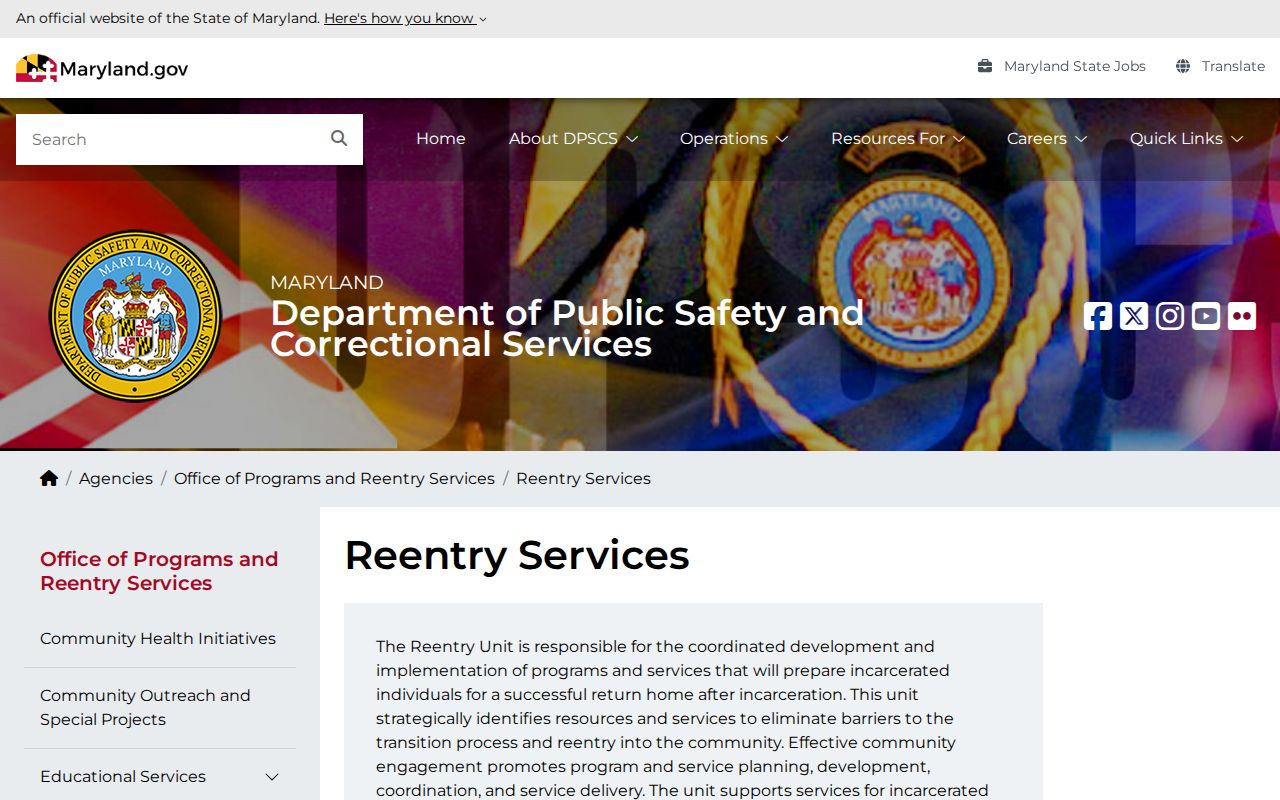
The phrase does not mean that a projected date appears in the public DOC offender search.
Victim Services uses another term, expected sentence expiration date, for an eligible registered-victim channel. That is not a general public date lookup either. Health-services contract specifications require release continuity work such as a care form, chronic-medication planning, and Medicaid-related steps. These are program or contract duties, not a guarantee of identical aid to each person. No reviewed authoritative statewide source promises a fixed gate-money sum, universal cash allowance, or guaranteed ride at release.
Maryland DOC Release Trends
DPSCS's long-run Sentenced Intakes and Releases table ends in fiscal year 2018. It reports 9,222 sentenced releases that year, including 8,551 male and 671 female releases. The comparison count was 14,775 in FY2009, while the series peak was 16,825 in FY1998. Those figures document a historical decline, not a live Maryland DOC released-inmate total.
A 2022 DPSCS recidivism report uses another frame. It says the sentenced population had declined twenty percent since 2009 and intakes and releases nearly sixty-four percent, while average length of stay increased twenty-nine percent and average sentence length rose ten percent during the preceding six years. Definitions and time periods should remain attached to their own report rather than being merged into the older series.
The DOC Annual Data Dashboard provides current official trend displays with selectable context.
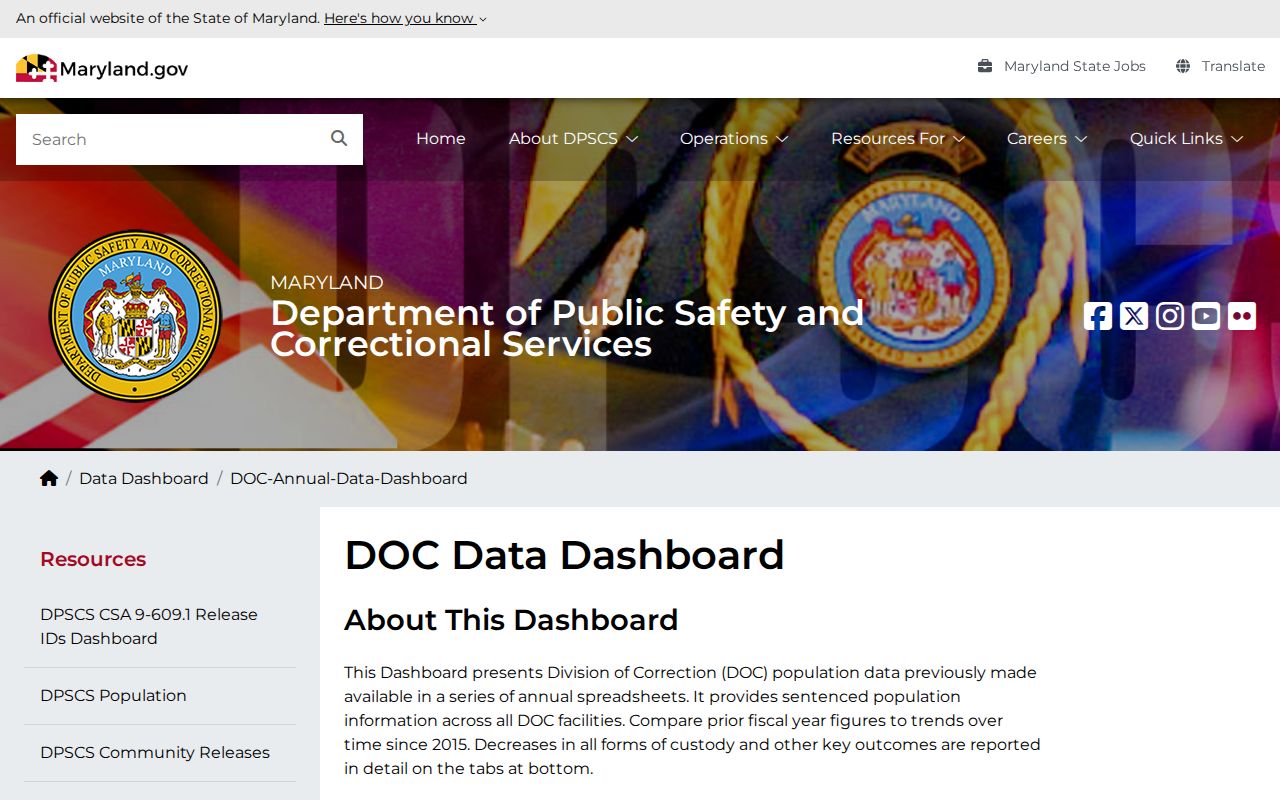
Any dashboard citation should preserve its filters, visible as-of date, and fiscal year because the display is not an individual release record.
The Maryland Parole Commission reported 5,931 parole hearings and 794 releases on parole from DPSCS and local detention facilities in FY2024, along with eighteen medical paroles. That is a narrower parole measure. It cannot substitute for all prison exits, all sentence expirations, or all local jail releases.
Note: Historical totals show system trends, while an individual release still requires a person-specific custody or court record.
DOC and Maryland County Releases
The DOC offender search belongs to the state-prison lane. Someone who left a county detention center on bond, after time served, or through a local court order is recorded by that county or city custodian. Most Maryland local detention centers are county-run, but Baltimore City's major adult booking and pretrial institutions are DPSCS-operated. The facility type, not just its location, determines which office owns the record.
When a county jail name disappears and a state DOC result appears, the movement likely continued confinement under a state commitment. When neither system shows the person, the answer can still be transfer, federal custody, immigration custody, a search mismatch, or lawful release. The Maryland County Directory routes local release questions to the locality that held the person.
| Feature | DOC state-prison lane | County jail lane |
|---|---|---|
| Typical custody | People committed to state correctional authority | Pretrial, local sentence, bond, and court processing |
| Current public check | DPSCS locator for covered placement | County roster where offered |
| Release proof | DPSCS event, order, computation, VINE, and court | County release entry and court order |
| Transfer clue | Receiving state facility or agency record | Movement into DOC, another county, BOP, or ICE |
| Request holder | DPSCS Public Information Act coordinator | County or city records custodian |
Note: A work-release center, police processing room, and prison perform different custody roles, even when each can record a physical exit.
Request Maryland DOC Release Records
The DPSCS Public Information Act page and fillable form provide the historical-release route that the DOC offender search lacks. Requests go to the Public Information Act Coordinator, Office of Constituent Services, 6776 Reisterstown Road, Suite 212, Baltimore, Maryland 21215, or dpscs.pia@maryland.gov. Ask for an existing record, not a custom statewide report or new analysis.
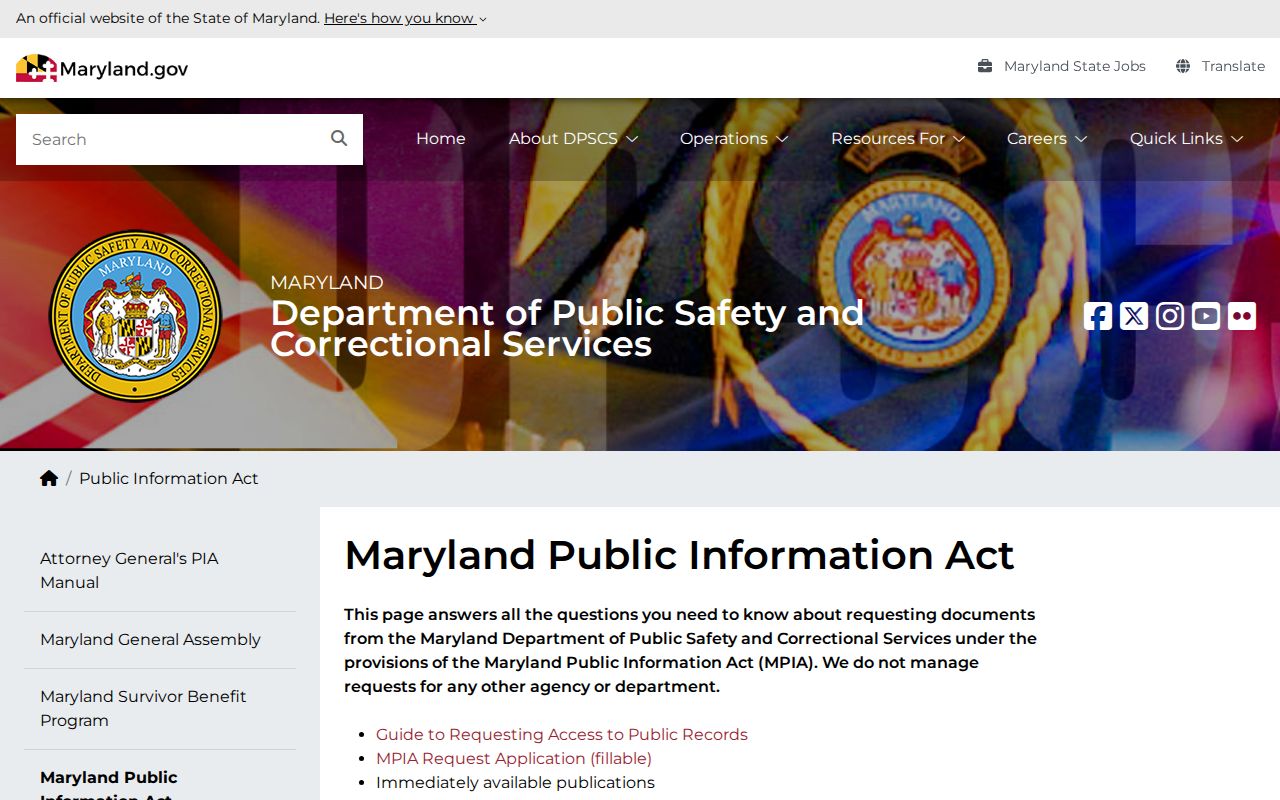
The DPSCS page also describes fees, exclusions, redaction, and the separate process for a person seeking their own base or medical file.
A purpose-neutral request can identify the commitment and release or discharge event, actual release date and type, receiving agency if the event was a transfer, maximum expiration date, projected mandatory-supervision date, diminution-credit ledger, recalculation history, written parole or mandatory-supervision order, and a publicly disclosable completion document. Include a DOC or commitment number, date of birth, court case, last facility, and date range when known. Ask for electronic production and segregable public portions.
DPSCS provides two hours of search and preparation without charge. It lists fifty cents per copy page, another fifty cents per certified page, postage, cost estimates, possible advance payment, and case-specific waiver review. Totals of one dollar or less are not charged. General Provisions Section 4-203 generally requires a prompt grant or denial within thirty days. If production will take more than ten working days, the response must give required timing, fee-range, and delay information.
Focused request: Name the person, record, custodian, facility, identifiers, and date range, then request electronic copies and advance fee notice.
Note: Send the request to the office that created the record because DPSCS does not hold every Maryland jail release file.
Maryland's Public Information Act covers existing records, but exemptions can protect medical, personnel, privileged, security, personal, and investigatory material. A release date may be disclosed while other parts remain redacted. Local jails, police agencies, courts, BOP, and ICE hold their own records and are outside a DPSCS request. The statewide search and records framework on the Maryland released inmates homepage explains how those separate lanes fit together.